 +86-18968933800
 No.515, Lingxi Strait Avenue, Cangnan, Wenzhou, Zhejiang, China


 English
 Français
 Español
 Deutsch
Blog ·
Blog ·
Blog ·
Blog ·
Blog ·
Blog ·
Blog ·
Blog ·
Blog ·
Blog ·
Blog ·
Blog ·
Blog ·
Blog ·
Blog ·
Blog ·
Custom Holographic Acrylic Keychains: Manufacturing Advantages, Design Options, and Wholesale Applications
Introduction
Custom holographic acrylic keychains have become an increasingly popular choice for brands, retailers, event organizers, creative studios, and promotional merchandise buyers. They combine the visual appeal of rainbow-shimmer effects with the practical value of a lightweight, durable, and highly customizable accessory. Unlike ordinary printed keychains, a holographic acrylic charm can change appearance as it moves through different lighting conditions, creating a dynamic visual effect that attracts attention on retail shelves, at exhibitions, in fan communities, and in social media content.
The Holographic Acrylic Keychain Custom Rainbow Shimmer Epoxy Charm is designed for business buyers seeking a distinctive product that can be manufactured in bulk and adapted to different branding requirements. It is suitable for promotional giveaways, retail resale, event merchandise, loyalty programs, fashion accessories, anime and character collections, souvenir shops, corporate gifts, and campaign merchandise.
This product is manufactured from acrylic sheets and can be customized in shape, size, color, artwork, printing, surface finish, packaging, and hardware configuration. Double-sided printing allows the two sides to carry the same or different designs, while an optional epoxy coating provides a glossy, raised, and protective finish. Laser cutting supports precise outlines, smooth edges, and accurately positioned attachment holes.
For B2B purchasers, product appearance is only one part of the sourcing decision. Production consistency, communication, sampling speed, order flexibility, packaging capability, quality control, and delivery reliability are equally important. A professional acrylic product manufacturer must therefore combine creative support with industrial equipment and an organized production process. The manufacturing capabilities behind this custom keychain include graphic design, UV printing, laser cutting, engraving, shaping, polishing, hardware assembly, inspection, and packaging.
This article explains the product’s design advantages, material performance, customization options, manufacturing workflow, business applications, purchasing considerations, and quality-control strengths. It also compares the product with conventional keychain formats and provides practical answers to frequently asked questions from wholesale and OEM buyers.
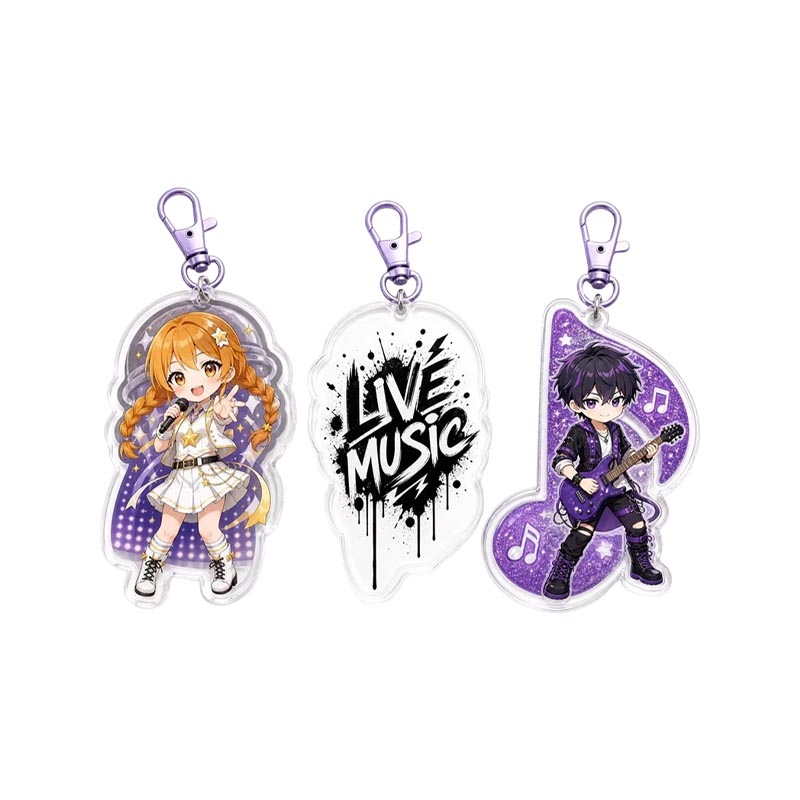
Holographic Acrylic Keychain Custom Rainbow Shimmer Epoxy Charm
What Makes a Holographic Acrylic Keychain Different?
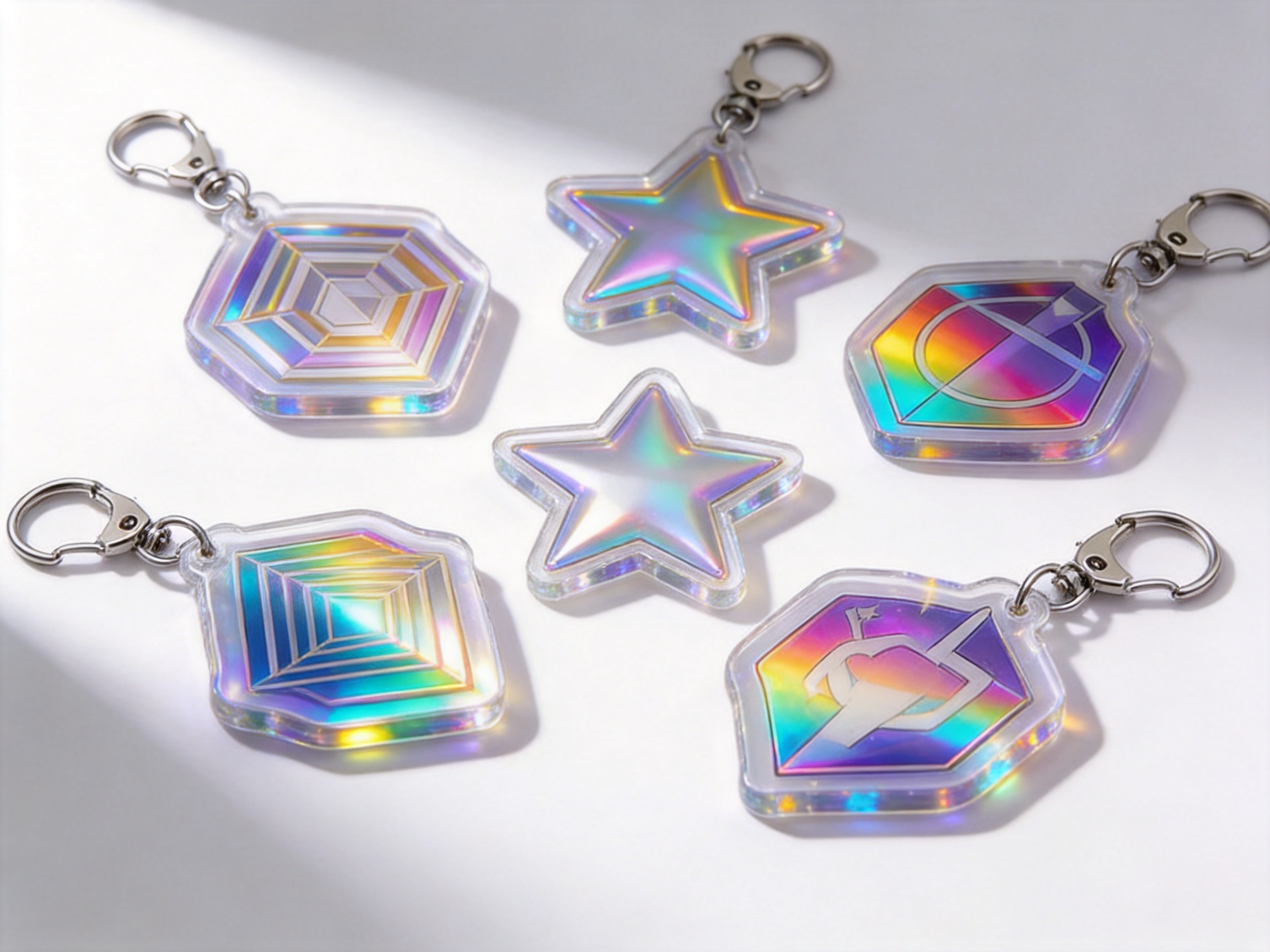
Acrylic keychains are valued for their clean appearance, low weight, strong visual clarity, and flexible manufacturing possibilities. The holographic version adds another layer of visual interest. Its rainbow shimmer reflects and refracts light, producing shifting colors that may appear different depending on viewing angle, background, and lighting conditions.
This changing appearance gives the product a premium and animated quality without requiring complex electronic components. The keychain remains a simple, portable accessory, but its surface effect helps it stand out from flat printed plastic, paper tags, standard metal charms, and ordinary transparent acrylic products.
The holographic effect is especially useful for designs that depend on color, motion, fantasy, or visual impact. Cartoon characters, illustrations, logos, lettering, abstract graphics, celestial themes, gaming artwork, beauty branding, and fashion motifs can all benefit from the reflective background. When combined with a custom silhouette and epoxy coating, the final charm can look more like a collectible merchandise item than a basic promotional accessory.
The product is also suitable for designs that need to remain visible from multiple angles. Full-color printing can be applied to both sides, allowing the keychain to display artwork whether it is hanging from a bag, attached to a zipper, or placed on a retail counter. For designs with different front and back artwork, double-sided customization can create a more complete storytelling effect or provide space for a logo, slogan, character detail, website-free product code, or campaign message.
Visual movement without electronic complexity
One of the main advantages of holographic acrylic is that it creates a sense of movement through light. The color shift is produced by the reflective surface rather than by batteries, lighting modules, or mechanical parts. This reduces product complexity and supports convenient storage, packaging, shipment, and everyday use.
For buyers, this means that a visually impressive item can be produced at a practical cost compared with electronic promotional products. The keychain is easy to include in gift packs, mailers, event bags, subscription boxes, retail displays, and promotional campaigns.
Lightweight appeal for everyday use
Acrylic is substantially lighter than many metal alternatives of similar size. The listed packaging information gives an approximate gross weight of 0.02 kilograms per unit, although the final weight may vary according to dimensions, thickness, hardware, protective packaging, and epoxy coverage. The low weight makes the charm comfortable to carry and helps reduce shipping volume for wholesale orders.
Lightweight merchandise is especially valuable for brands selling online or distributing products at events. It can be attached to backpacks, handbags, keys, pencil cases, luggage, pouches, and mobile accessories without adding significant bulk. It is also suitable for international shipments where weight and package volume influence freight costs.
Premium appearance at a scalable production level
Holographic film effects, full-color printing, precision cutting, and epoxy finishing can create a premium appearance while remaining compatible with bulk production. This balance is important for retail brands and promotional agencies. A product may need to look distinctive enough to support a higher perceived value, but it must also be practical to manufacture in quantities ranging from small trial orders to larger campaigns.
The product supports custom designs rather than restricting buyers to fixed shapes or preselected artwork. That allows each customer to develop a keychain aligned with a specific brand identity, character series, event theme, or product launch.
Material and Construction Advantages
The foundation of the product is high-strength acrylic sheet material. Acrylic is widely used for creative merchandise because it offers a combination of clarity, rigidity, relatively low weight, and good impact resistance. It can be cut into irregular outlines, printed with detailed artwork, drilled or routed for attachment points, and finished with additional coatings.
Compared with paper-based promotional items, acrylic is more durable and better suited to repeated handling. Compared with some brittle decorative materials, it offers a practical balance between hardness and weight. Compared with many low-quality flexible plastics, acrylic can provide a cleaner surface and more precise shape definition.
Color retention is another important product consideration. The manufacturing description specifies long-lasting color retention and scratch-resistant full-color printing. Actual durability depends on artwork coverage, storage, handling, exposure to abrasion, and the selected finish, but the production process is intended to create a stable and attractive printed surface for normal use.
Double-sided printing capability
Double-sided printing increases the usable design area of the keychain. A buyer may choose to place the same image on both sides for consistent visibility, or use two different graphics. For example, a character can appear on the front while a logo, collection name, or supporting illustration appears on the back.
Different artwork on each side can also help create a collectible series. A retail brand may release several characters with coordinated back designs. An event organizer may place the event identity on one side and a commemorative date or message on the other. A corporate buyer may combine a campaign image with a company emblem.
Artwork should be prepared in a high-resolution format and reviewed carefully during sampling. Recommended file formats include AI, PSD, PDF, and SVG. Vector files are particularly useful for logos, line art, lettering, and shapes that require clean scaling.
Epoxy coating for gloss and protection
An epoxy coating can be added to create a glossy, raised surface. This finish makes selected areas appear more dimensional and can strengthen the visual contrast between printed elements. It may also provide an additional protective layer over the artwork, although buyers should still specify their expected handling conditions and request a sample when surface durability is critical.
Epoxy is useful for logos, small character details, lettering, icons, and complete front surfaces. The coating specification should be discussed during quotation because thickness, coverage, curing time, and artwork complexity can influence cost and production scheduling.
Reliable metal hardware
The keychain is supplied with metal keychains, jump rings, and clasps. These components connect the acrylic charm to keys, bags, zippers, or other items. High-quality hardware helps improve the user experience and reduces the risk of rust or premature failure during normal use.
Hardware can also influence the style of the finished product. Buyers may request different clasp forms, ring sizes, colors, or combinations depending on the target market. A fashion accessory brand may prefer a decorative metal tone, while a promotional campaign may prioritize standard, cost-efficient hardware.
Customization Options for B2B Buyers
The product is intended for custom manufacturing rather than simple off-the-shelf purchasing. Buyers can develop a specification that reflects their artwork, sales channel, budget, and intended audience.
Custom shape and outline
Irregular shapes are supported, making it possible to follow the outline of a character, mascot, logo, product silhouette, emblem, object, or abstract design. A custom die-line or vector outline can be prepared based on the approved artwork. Laser cutting then follows the required contour with high precision.
Shape customization is one of the clearest advantages over generic keychains. A standard rectangular or circular charm may be functional, but a distinctive outline can strengthen recognition and make the product more memorable. For character merchandise, cutting close to the illustrated silhouette can make the product feel more faithful to the original artwork.
Custom size and thickness
There is no single required size for every application. Small charms may be appropriate for zipper pulls, blind-box merchandise, and event giveaways. Larger pieces may be preferred for display-oriented retail products or character collections. The listed packaging dimensions are approximately 10 by 10 by 0.5 centimeters for a single packaged unit, but the product size can be adjusted according to the approved design.
Size decisions should take into account visual detail, attachment hardware, shipping requirements, retail packaging, and user comfort. Extremely fine details may require sufficient dimensions to remain visible, while oversized charms may need additional support or stronger packaging.
Custom colors and artwork
Customers can submit custom designs and customized color requirements. Full-color printing supports illustrations, gradients, logos, photographs, typography, and cartoon graphics. The holographic base can be used as an active part of the design or partially covered by printed layers.
Artwork should identify important elements clearly. Buyers are encouraged to specify transparent areas, white ink requirements, color expectations, text placement, bleed areas, hole positions, and whether the holographic background should remain visible. A production sample is recommended for designs where color matching or transparency is especially important.
Custom front and back designs
Front and back artwork may be identical or different. This option is useful for promotional products that need to communicate more information without increasing the physical size. Buyers can use the reverse side for a secondary logo, slogan, character profile, collection number, or campaign message.
When different artwork is used, the orientation of both sides should be confirmed. This is particularly important for asymmetrical designs, directional characters, and text. A proofing stage helps prevent upside-down or incorrectly aligned printing.
Custom epoxy coverage
Epoxy can be specified for the full front face, selected design elements, or both sides when appropriate. Partial epoxy may emphasize logos or character features, while full-surface epoxy can create a smooth, glossy finish across the main artwork.
The correct finish depends on the product concept. A minimalist logo may benefit from a clean gloss layer. A colorful cartoon charm may benefit from a thicker raised effect. A retail collection may use different finishes to distinguish product tiers or limited editions.
Custom packaging
Packaging can be personalized for promotional distribution or retail resale. Options may include individual bags, backing cards, header cards, branded labels, collection cards, barcode areas, and protective arrangements for larger shipments. Packaging requirements should be discussed early because they affect material purchasing, assembly, storage, and delivery planning.
For retail buyers, professional packaging can help communicate product information and increase shelf appeal. For event organizers, simpler individual packaging may support fast distribution. For e-commerce sellers, stronger protective packaging may be more important than elaborate presentation.
Advanced Manufacturing Process
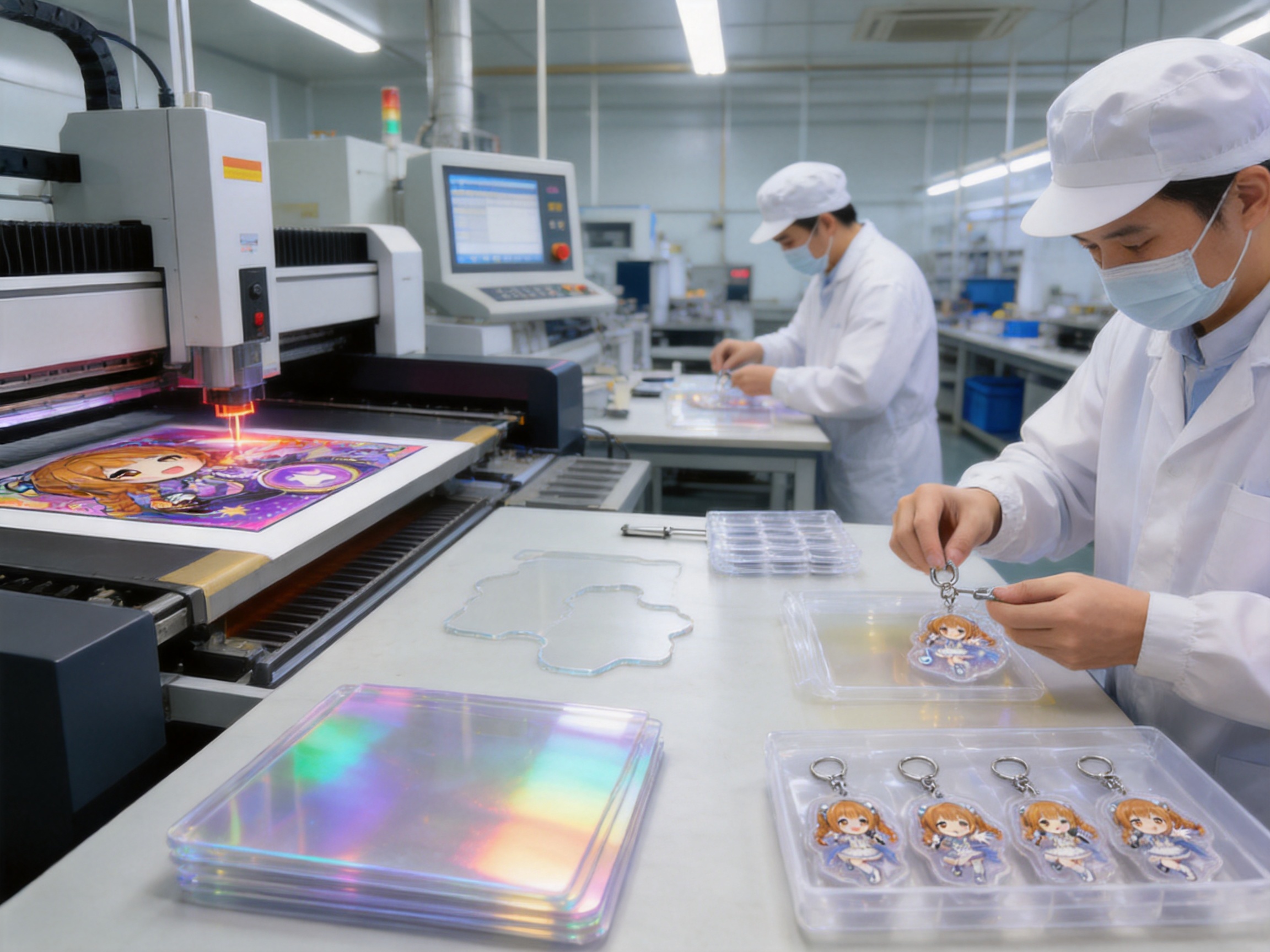
The quality of a custom acrylic keychain depends on the coordination of multiple production stages. A professional manufacturer must manage artwork preparation, material handling, printing, cutting, finishing, hardware assembly, inspection, and packing as one connected process.
1. Design review and pre-production preparation
Production begins with artwork review. The design team checks file quality, dimensions, color requirements, transparency, cutting lines, hole positions, text readability, and the intended printing method. If an artwork file needs adjustment, the design team can prepare a production-ready version for customer approval.
Professional design support is especially useful for international buyers who may have a finished concept but need help converting it into a suitable manufacturing file. A clean production file reduces the risk of cutting errors, missing details, poor alignment, or unexpected background effects.
The company reports that its experienced graphic design team can provide design drafts within approximately two hours for suitable projects. Timing depends on artwork complexity, communication speed, and revision requirements, but rapid design support can help buyers move from concept to sampling more efficiently.
2. Material selection and sheet preparation
After artwork approval, acrylic sheets are selected according to required thickness, transparency, color effect, and intended application. The material is inspected before processing to reduce the risk of visible defects. Sheets are then prepared for printing or cutting according to the production sequence.
Material planning is important for bulk production because it supports consistent appearance across units. When a design is divided across multiple pieces, the manufacturer must also maintain consistent positioning and color performance throughout the order.
3. UV printing and graphic reproduction
UV printing equipment is used to reproduce full-color artwork on the acrylic surface. UV printing is suitable for detailed graphics, logos, patterns, and illustrations. It can support vibrant visual output and precise reproduction of approved designs.
Printing parameters must be adjusted according to the material surface, artwork coverage, white ink requirements, and desired transparency. The holographic effect may be intentionally left visible in selected areas or covered beneath printed layers. A proof or sample allows the buyer to confirm how the printed colors interact with the reflective background.
Double-sided printing requires careful handling and alignment. If the front and back designs are different, the artwork must be registered correctly so the finished charm presents a balanced appearance from both sides. Quality inspection should review not only color but also position, text sharpness, and edge coverage.
4. Laser cutting and hole alignment
Laser cutting is used to create the custom outer shape and attachment hole. Compared with rough manual cutting or generic punched shapes, laser processing supports precise contours and repeatable production. It is suitable for irregular outlines, small details, and designs with carefully positioned holes.
Clean edge quality is important because the outer contour is part of the visual identity of the charm. The stated production capability emphasizes smooth, burr-free cutting. Proper machine settings, material control, ventilation, and operator experience all contribute to a neat result.
Hole alignment is also critical. If the hole is too close to the edge, too small for the selected ring, or positioned inconsistently, the finished product may be difficult to assemble or use. The cutting file should therefore include a confirmed hole diameter and center position.
5. Edge treatment and polishing
After cutting, pieces may undergo edge treatment, cleaning, and polishing. These steps help remove residue, improve smoothness, and prepare the acrylic for hardware assembly and final inspection.
Polished edges can make the product appear more refined, particularly when the acrylic contour is visible. Edge quality also affects handling because smooth edges are more comfortable for users and less likely to catch on packaging materials.
6. Epoxy application and curing
If the order includes epoxy, the coating is applied according to the approved finish. Operators must control coverage, thickness, surface cleanliness, and curing conditions. A consistent epoxy layer helps maintain a uniform appearance across the batch.
Epoxy application requires attention to dust control and curing time. The pieces should be positioned securely while the coating settles and hardens. After curing, the surface is checked for bubbles, uneven areas, contamination, incomplete coverage, and edge overflow.
7. Hardware assembly
Metal hardware is attached after the acrylic component has passed the relevant finishing stages. The process may include fitting jump rings, connecting clasps, and attaching the main keychain ring. Assembly should be firm without damaging the acrylic or scratching the printed surface.
Hardware inspection includes checking connection strength, opening and closing function, rust resistance expectations, and visual consistency. The correct hardware style should be confirmed before mass production because changing components after assembly can increase cost and delay.
8. Final inspection and packaging
Finished units are inspected for printing defects, cutting irregularities, surface damage, epoxy quality, hardware attachment, and packaging accuracy. The inspection standard should be agreed with the buyer for large orders, particularly when the product is intended for retail sale or high-visibility promotional campaigns.
After inspection, the keychains are individually packed or arranged according to the approved packaging plan. Protective packaging helps reduce scratching and impact during transportation. Carton packing should also account for the final quantity, package dimensions, gross weight, and shipping method.
Manufacturing Strengths and Quality Management
The manufacturer behind this product operates a certified quality management system under ISO 9001. Certification does not eliminate the need for product-specific inspection, but it indicates that documented management procedures are used to support consistent operations and quality control.
The factory is equipped with UV printers, engraving machines, laser cutting machines, and other specialized equipment. This equipment supports a one-stop workflow covering design, material cutting, printing, shaping, polishing, and packaging. A consolidated process can simplify communication for buyers because the key production stages are coordinated by one supplier rather than divided among unrelated vendors.
In-house capability can also improve customization flexibility. When design adjustments, cutting revisions, or finishing changes are required, the manufacturer can coordinate the response across departments. This is valuable for projects with unusual shapes, multiple versions, changing artwork, or tight sampling schedules.
Rapid sampling support
For buyers launching a new collection or testing a promotional concept, sample speed can influence the entire project timeline. The manufacturer reports that urgent samples may be completed within approximately 24 hours, depending on design complexity and order requirements. This should be confirmed for each project, but the capability demonstrates an emphasis on responsive development.
Fast sampling allows a buyer to evaluate color, holographic interaction, size, shape, hardware, epoxy finish, and packaging before placing a larger order. It also reduces the risk of committing to a mass-production specification that has not been physically reviewed.
Support for trial orders and mass production
The product is positioned for both promotional and retail applications. Standard information lists a minimum order quantity of 100 pieces, while the product FAQ indicates that flexible options may be available from 50 pieces for certain custom orders. Because MOQ can vary by design, material, packaging, and production schedule, buyers should confirm the applicable quantity before final quotation.
This flexibility is useful for small brands, independent artists, event organizers, and retailers testing a new design. Larger companies can also use the same production system for campaign quantities, seasonal merchandise, employee gifts, or multi-design collections.
International sourcing experience
The company serves customers in South Korea, Japan, the United States, and other international markets. Experience with overseas buyers can support clearer communication regarding artwork formats, packaging expectations, shipping arrangements, production schedules, and export documentation.
International buyers should still provide a complete purchase specification. Clear information about quantity, delivery destination, packaging, artwork, inspection expectations, and shipping preference helps reduce avoidable misunderstandings.
Advantages Compared with Competing Keychain Formats
| Comparison Point | Holographic Acrylic Keychain | Basic Printed Plastic Keychain | Metal Keychain |
|---|---|---|---|
| Visual effect | Rainbow shimmer and changing reflective appearance | Usually flat color or transparent printing | Metallic appearance, often less suitable for detailed full-color art |
| Weight | Lightweight and suitable for bags, zippers, and event distribution | Generally lightweight | Often heavier depending on size and construction |
| Shape flexibility | Irregular custom outlines and precise laser cutting | May support custom shapes but with fewer finishing options | Custom tooling may increase cost and development time |
| Artwork capability | Full-color, double-sided, holographic, and epoxy options | Commonly supports basic printed graphics | Excellent for embossed or enamel effects but may limit detailed gradients |
| Development speed | Suitable for rapid digital sampling and flexible revisions | Depends on the printing process | Tooling and casting may require additional lead time |
| Retail positioning | Collectible, fashionable, colorful, and giftable | Practical and cost-focused | Premium, durable, and often heavier |
The holographic acrylic format does not replace every other keychain material. Metal may be preferable when maximum weight, embossed depth, or a traditional premium feel is required. Basic plastic may be suitable for the lowest-cost campaign. However, holographic acrylic offers a strong combination of visual impact, light weight, customization, and scalable production.
Compared with ordinary printed acrylic, the rainbow shimmer provides stronger shelf presence. Compared with metal, it can reproduce complex illustrations and gradients more easily while remaining lightweight. Compared with paper or fabric accessories, it offers a more durable and polished presentation.
The ability to combine multiple effects is another competitive advantage. A buyer can use a custom irregular outline, holographic base, full-color double-sided printing, epoxy coating, and branded hardware in one product. This layered approach creates more opportunities for product differentiation than a standard single-finish keychain.
Commercial Applications
Corporate promotional giveaways
Companies can use custom keychains for trade shows, product launches, employee appreciation programs, customer loyalty campaigns, and branded events. A small, lightweight item is easy to distribute, and the holographic effect can attract attention at crowded exhibitions.
Corporate buyers may place a logo on one side and a campaign message on the other. Alternatively, the keychain can incorporate a mascot, product icon, or visual identity element. Custom packaging can help create a more coordinated presentation alongside brochures, coupons, samples, or gift sets.
Retail resale and wholesale supply
Retailers, distributors, souvenir stores, fashion accessory shops, and gift businesses can source customized keychains for resale. The product’s collectible quality makes it suitable for themed series, seasonal releases, artist collaborations, and limited-edition designs.
Retail buyers should consider the target price, packaging style, display method, expected order quantity, and desired hardware. A collection may include multiple shapes or characters while maintaining a consistent holographic and epoxy finish.
Anime, character, and fan merchandise
Holographic acrylic is well suited to character merchandise because it can reproduce bright colors, expressive outlines, and detailed illustrations. Character designers and fan merchandise brands can use custom silhouettes and double-sided printing to create a more complete collectible item.
For a series, the manufacturer can produce coordinated designs with consistent dimensions, hardware, and packaging. Buyers should confirm intellectual property ownership or authorization before producing copyrighted or trademarked artwork.
Events and conferences
Event organizers can create commemorative keychains for conferences, festivals, exhibitions, fundraisers, conventions, and themed gatherings. The product can display the event logo, date, mascot, venue identity, or campaign theme.
Because the keychain is compact, it can be included in registration packs or distributed as a participation gift. For events with multiple access levels, different colors, shapes, or back designs can distinguish staff, speakers, guests, and attendees.
Non-profit and fundraising campaigns
Non-profit organizations can use custom acrylic charms to support awareness campaigns and fundraising programs. A memorable visual symbol can help supporters carry and share the campaign identity after the event has ended.
Different quantities and packaging choices allow organizers to match production with expected fundraising volume. The buyer should calculate the landed cost, suggested selling price, shipping expenses, and packaging requirements before confirming the order.
Fashion and lifestyle accessories
Fashion brands can use holographic keychains as bag charms, zipper accessories, promotional add-ons, or small seasonal products. The rainbow finish aligns naturally with colorful, playful, streetwear, youth, festival, and pop-culture aesthetics.
Brands seeking a more premium look can combine an artistic silhouette, selective epoxy, coordinated hardware, and custom backing cards. The product can also be included as a gift-with-purchase item to increase customer engagement.
Ordering and Project Planning
A successful custom order begins with a complete product brief. The brief should identify the artwork, quantity, size, thickness, printing sides, holographic requirements, epoxy coverage, hardware type, packaging, delivery location, and desired arrival date.
Artwork checklist
Before quotation, buyers should prepare an editable or high-resolution file in AI, PSD, PDF, or SVG format. The design should include a clear cutting outline and indicate any transparent areas. Text should be converted to outlines when appropriate, and small details should be reviewed for production visibility.
Buyers should also specify whether the holographic background should be visible through transparent sections. If white ink is needed beneath selected colors, this should be marked in the artwork or explained in the production notes.
Sample approval
A sample should be reviewed for overall dimensions, color, print alignment, surface finish, shape accuracy, hardware connection, and packaging. The buyer should compare the sample against the approved digital proof and record any requested changes before mass production.
For large or high-value orders, approval should be documented. A signed proof, approved sample, or written confirmation can help ensure that the production team has a clear reference standard.
MOQ, timing, and logistics
The listed standard MOQ is 100 pieces, while flexible orders may be possible from 50 pieces depending on project details. The stated delivery time is approximately 30 days. Actual lead time can vary according to quantity, artwork approval, sample requirements, epoxy curing, packaging complexity, seasonal demand, and shipping arrangements.
Shipping options include sea freight, air freight, and express delivery. Sea freight may be appropriate for larger, less urgent orders. Air freight or express delivery may be preferred when timing is more important than transportation cost. Buyers should request a complete quotation that distinguishes production time from transit time.
Payment terms listed for the product include T/T and L/C at sight. The final payment schedule should be confirmed in the commercial quotation or sales contract.
Packaging and storage
Individual packaging helps protect the printed and epoxy surfaces from scratching during handling. Finished units should be stored in a clean, dry environment and protected from excessive pressure, heat, and abrasion before shipment.
Retail packaging should be tested for compatibility with the hardware and charm dimensions. If a backing card includes a hole for hanging display, its position should align with the packaged product. For e-commerce fulfillment, additional protective material may be appropriate.
How the Product Supports Brand Differentiation
In competitive retail and promotional markets, a product must be recognizable within seconds. Holographic acrylic supports differentiation by combining color movement, reflective depth, and custom shape. These qualities can make a small accessory appear more active and visually rich than a flat, conventional giveaway.
Brand differentiation can be developed at several levels. The silhouette can reflect a logo or character. The artwork can match the brand’s color system. The holographic surface can reinforce a futuristic, playful, fashionable, or celebratory identity. Epoxy can highlight selected features. Packaging can connect the keychain with a wider product collection.
Consistency is equally important. If a brand produces a series, all designs should follow agreed standards for acrylic thickness, printing position, hardware, packaging, and finish. A professional manufacturer can help coordinate these details across multiple designs and production batches.
The product also supports content creation. Reflective surfaces can produce attractive effects in photography and video, especially under direct or angled lighting. Retailers and artists may use this visual behavior in product previews, unboxing content, social media campaigns, and event displays.
Sustainability and Responsible Product Planning
Buyers should consider the full product life cycle when ordering acrylic merchandise. Accurate forecasting can help avoid unnecessary overproduction. Digital sampling and design approval before mass production can reduce the likelihood of unusable inventory caused by artwork errors.
Packaging should be selected according to the product’s actual protection needs. Excessive packaging can increase material use and shipping volume, while insufficient packaging may lead to damage and waste. Buyers can discuss practical packaging alternatives with the manufacturer.
Responsible sourcing also includes clear artwork authorization, reasonable production standards, proper worker safety practices, and transparent quality expectations. An ISO 9001 quality-management framework can support process consistency, but buyers may also request project-specific inspection information when required by their internal procurement procedures.
Frequently Asked Questions
Q1: What is the minimum order quantity?
The standard product information lists an MOQ of 100 pieces. Flexible options may be available from 50 pieces for certain custom designs or trial orders. The exact MOQ should be confirmed based on size, artwork, epoxy requirements, hardware, packaging, and production scheduling.
Q2: Can the keychain have different designs on the front and back?
Yes. The product supports double-sided printing, and the two sides may use the same artwork or different designs. Buyers should confirm orientation, alignment, transparency, and any white-ink requirements during the proofing stage.
Q3: Can epoxy be added to the keychain?
Yes. Epoxy coating can be added for a glossy, raised, and protective finish. It may cover the entire printed face or selected artwork areas. The desired coating coverage and appearance should be specified before quotation.
Q4: What design file formats are accepted?
AI, PSD, PDF, and SVG files are accepted. High-resolution vector artwork is recommended for logos, line art, cutting outlines, and text. Buyers should clearly mark transparent areas, cutting lines, hole positions, and special color requirements.
Q5: What shapes can be produced?
Custom irregular shapes are supported. The keychain can follow a character, mascot, logo, object, symbol, or other approved outline. Laser cutting helps produce smooth edges and accurate contours.
Q6: Is the holographic effect printed or built into the material?
The holographic appearance is associated with the reflective acrylic construction or surface treatment and interacts with the printed artwork. The exact visual result depends on the selected material, printing layers, transparency, lighting, and design coverage. A physical sample is recommended when the effect is central to the product concept.
Q7: Is the acrylic keychain suitable for retail resale?
Yes. It is suitable for gift stores, fashion accessory shops, anime retailers, souvenir businesses, online stores, and distributors. Custom shapes, packaging, double-sided printing, and epoxy finishing can help create a more marketable retail product.
Q8: What hardware is included?
The product is equipped with metal keychains, jump rings, and clasps. Buyers can discuss available hardware styles, finishes, sizes, and attachment requirements during the quotation process.
Q9: How long does production take?
The listed delivery time is approximately 30 days. The actual schedule depends on artwork approval, quantity, sample requirements, finish, packaging, and shipping arrangements. Urgent sampling may be possible in approximately 24 hours for suitable projects, but this should be confirmed before planning a campaign.
Q10: Which shipping methods are available?
Sea freight, air freight, and express delivery are available. The best method depends on order volume, destination, budget, and required arrival date. Production time and transit time should be reviewed separately.
Q11: Can the manufacturer help with design?
Yes. The graphic design team can support artwork preparation and production adaptation. Buyers can submit an initial concept, logo, sketch, or reference file and discuss the required shape, finish, and printing details.
Q12: Is the factory certified?
The manufacturer operates an ISO 9001 certified factory. Buyers with additional compliance, inspection, or documentation requirements should communicate those requirements before placing the order.
Conclusion
The custom holographic acrylic keychain is a versatile merchandise solution for companies and organizations that need more than a standard printed accessory. Its rainbow shimmer creates strong visual appeal, while acrylic construction keeps the product lightweight and suitable for everyday carrying. Double-sided printing expands the available design space, laser cutting supports irregular custom outlines, epoxy adds gloss and depth, and metal hardware provides practical attachment.
For B2B buyers, the strongest advantage is the combination of creative flexibility and organized manufacturing. The production system covers design support, UV printing, laser cutting, engraving, shaping, polishing, hardware assembly, inspection, and packaging. This one-stop approach can simplify communication and support projects ranging from small trial runs to larger promotional and retail orders.
The product is suitable for corporate gifts, branded giveaways, retail collections, anime and character merchandise, events, fundraisers, fashion accessories, and campaign programs. Buyers can improve project results by providing complete artwork, approving a physical sample, confirming MOQ and delivery time, selecting appropriate packaging, and specifying quality expectations before mass production.
When a brand needs a lightweight accessory with strong shelf appeal and broad customization potential, a holographic acrylic keychain offers a practical balance of appearance, function, and production scalability. With careful design planning and professional quality control, it can become an effective promotional item, collectible product, or branded merchandise component.
References
1. ISO, Quality Management Systems—Fundamentals and Vocabulary, ISO 9000 series reference materials.
2. ISO, Quality Management Systems—Requirements, ISO 9001 reference materials.
3. General acrylic material and fabrication principles for transparent polymer sheet products.
4. General UV printing process guidance for customized promotional merchandise.
5. General laser cutting and finishing practices for acrylic sheet fabrication.
6. Product specifications and manufacturing information supplied for the custom holographic acrylic keychain.
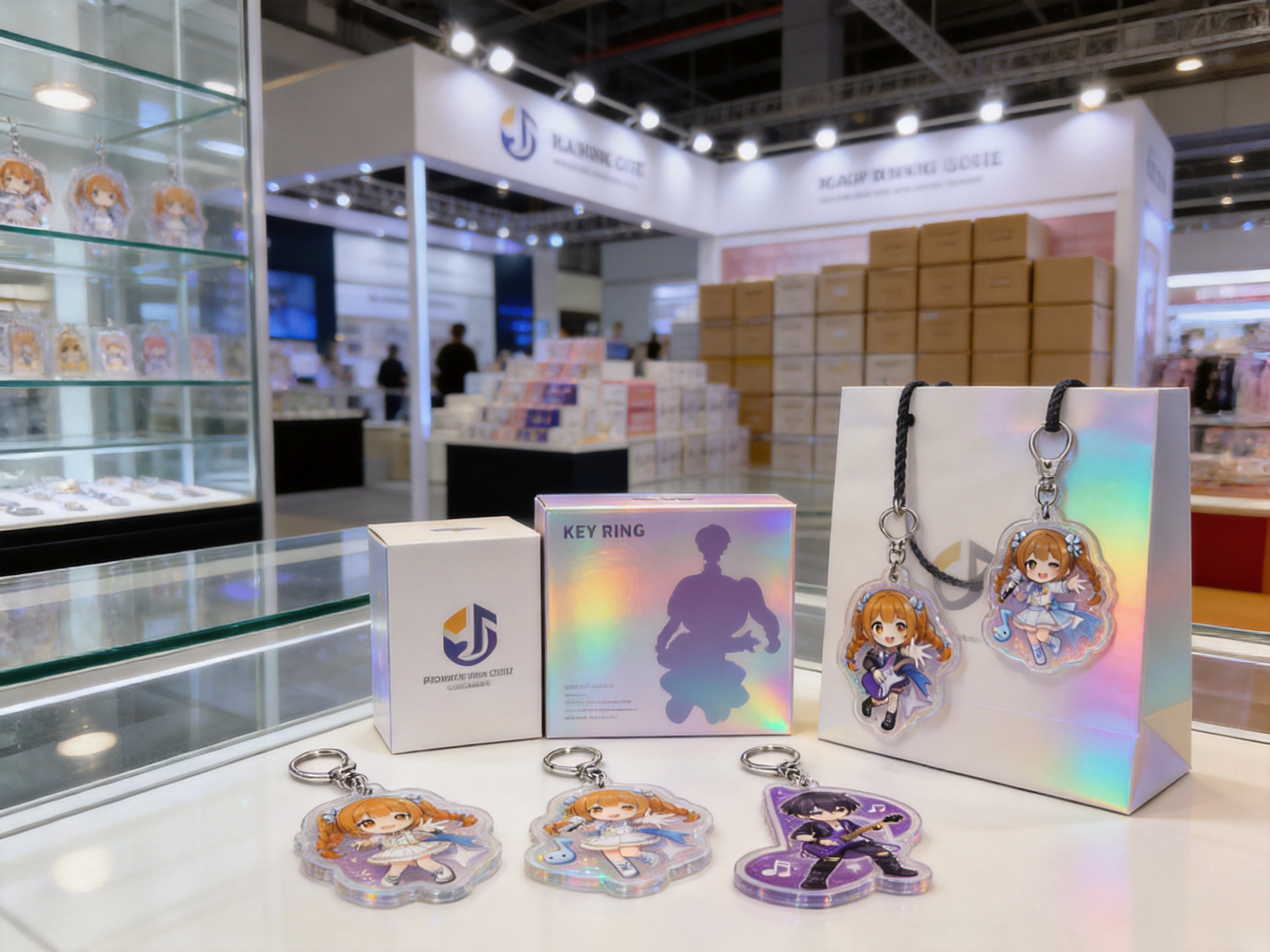
Product: Holographic Acrylic Keychain Custom Rainbow Shimmer Epoxy Charm

Ready to Begin?
Product Categories
Contact Information
 Email:
kaelissia.shop@gmail.com
 Phone:
+86-18968933800
 Address:
No.515, Lingxi Strait Avenue, Cangnan, Wenzhou, Zhejiang, China
QR Code
Copyright © Wenzhou Chuangheng Packaging Co., Ltd. All rights reserved.
