 +86-18968933800
 No.515, Lingxi Strait Avenue, Cangnan, Wenzhou, Zhejiang, China


 English
 Français
 Español
 Deutsch
Blog ·
Blog ·
Blog ·
Blog ·
Blog ·
Blog ·
Blog ·
Blog ·
Blog ·
Blog ·
Blog ·
Blog ·
Blog ·
Blog ·
Blog ·
Blog ·

Cube Storage Acrylic Display Case: A Clear, Customizable Solution for Organized Presentation
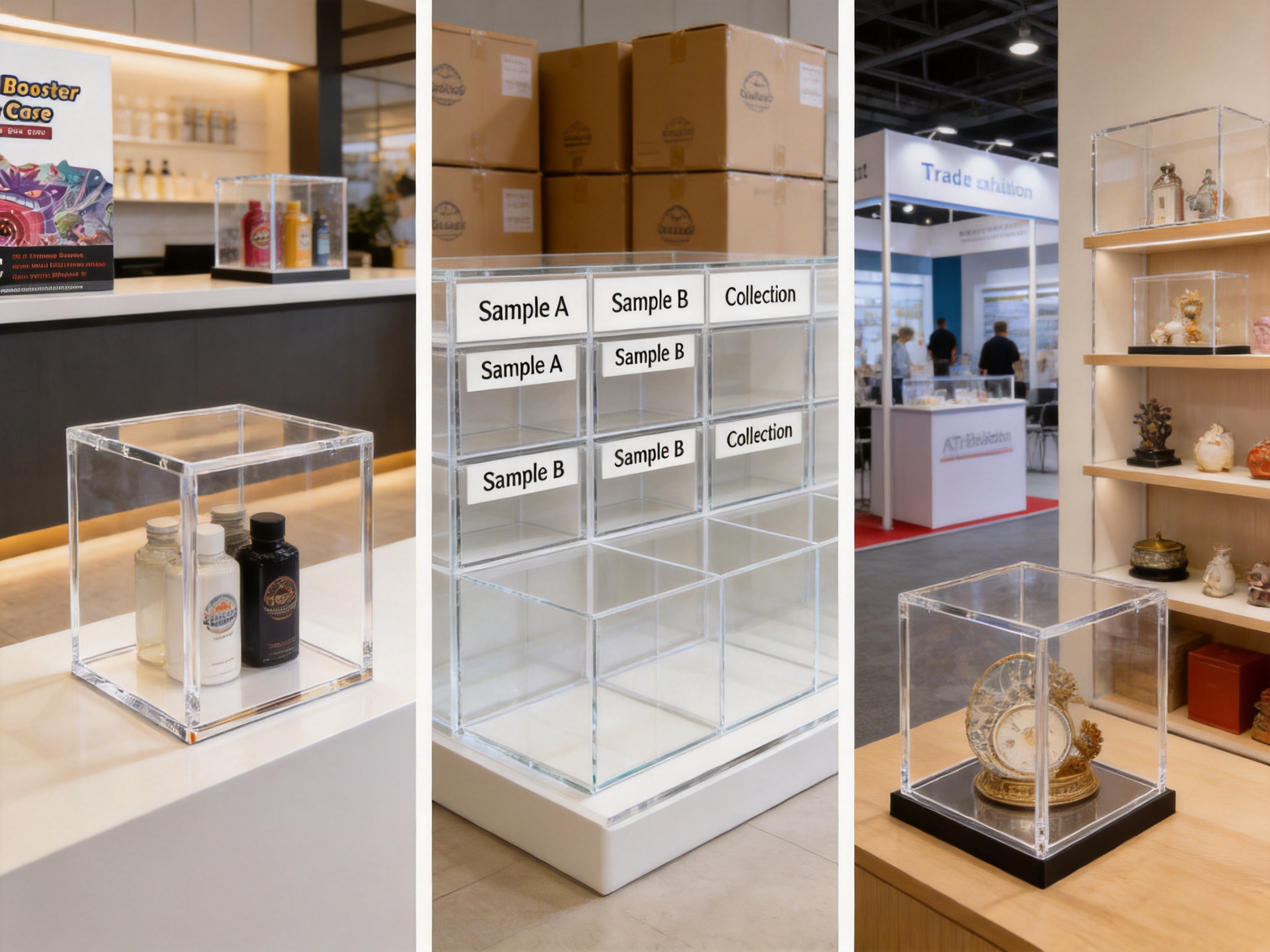
A well-designed display case does more than protect an item. It frames the product, improves visibility, supports organized storage, and communicates a sense of quality to customers, visitors, or collectors. The Cube Storage Acrylic Display Case is developed for these combined purposes. Its transparent acrylic construction, geometric cube format, adjustable interior design, and broad customization options make it suitable for retail presentation, sample organization, collection storage, promotional projects, exhibitions, and home decoration.
Unlike ordinary storage containers that conceal their contents or basic plastic boxes that provide limited presentation value, this acrylic display case is designed to make stored objects visible from multiple angles. The clear structure allows products, samples, figures, collectibles, promotional items, and decorative objects to remain easy to identify while receiving a clean level of protection from dust, handling, and accidental contact.
The case can be produced in customized sizes from approximately 50 millimeters to 300 millimeters, with internal bases and partitions available for different product formats. Acrylic thickness can also be adapted from 3 millimeters to 8 millimeters according to the required balance between appearance, weight, durability, and protection. These options allow buyers to develop a display solution around the item instead of forcing different products into a fixed-size container.
For wholesale buyers, importers, retailers, promotional agencies, exhibition contractors, and brands seeking consistent packaging or display equipment, customization is a central advantage. The product can incorporate logo engraving, UV printing, customized surface effects, personalized interior layouts, and branded packaging. Through an integrated manufacturing process that includes design support, material cutting, printing, shaping, polishing, inspection, assembly, and packaging, the product can be developed as a coordinated presentation solution rather than as a generic off-the-shelf box.
What Is a Cube Storage Acrylic Display Case?
A Cube Storage Acrylic Display Case is a transparent storage and presentation unit constructed primarily from acrylic panels. Its geometric structure creates a compact enclosure for products or objects while preserving visual access. The cube-inspired format provides a balanced appearance that works well in modern retail spaces, residential interiors, trade show booths, studios, museums, collection rooms, and promotional displays.
Acrylic, also known as polymethyl methacrylate or PMMA, is widely used in display applications because it combines optical clarity with relatively low weight and flexible processing characteristics. Compared with glass, acrylic can be easier to machine, print, engrave, shape, and customize. It also offers a practical alternative when a project requires repeated handling, branded surface decoration, or a variety of custom dimensions.
The case may be configured as an open-front display, a fully enclosed unit, a multi-panel cube, or a more specialized structure with internal compartments. The exact construction can be adjusted according to the product being displayed, the desired level of protection, the available space, and the buyer’s branding requirements.
Its rectangular product classification and modern styling make it compatible with many interior concepts. The transparent appearance keeps the display visually light, while the cube structure provides a defined and orderly presentation area. This combination is especially useful when several cases must be arranged together on shelves, counters, cabinets, exhibition walls, or retail fixtures.
Main Advantages of the Acrylic Cube Display Format
High Visual Clarity
One of the most important advantages of the display case is its clear acrylic construction. Transparent panels allow viewers to inspect the contents without opening the case. This supports faster product recognition and helps preserve the visual impact of the displayed item.
High-clarity panels are particularly useful for products that depend on color, surface detail, printed artwork, shape, or small decorative elements. Collectibles, promotional samples, cosmetic packaging, small electronics, handmade items, and branded merchandise can remain visible while receiving a more organized presentation.
Clear visibility also improves inventory identification. In a sample room or stock area, employees can often recognize the stored item without removing it from the case. In a retail environment, customers can view the product while the display remains neat and controlled.
Efficient Use of Space
The cube structure creates a compact footprint that can be used independently or combined with other units. Several cases can be arranged in rows, columns, grids, or staggered displays. This flexibility helps retailers and exhibitors use vertical and horizontal space more efficiently.
Because the case can be customized from small dimensions to larger formats, it can be designed for a single small object or for a group of coordinated items. Buyers can specify the external dimensions according to shelf depth, counter width, cabinet height, product size, or exhibition layout.
The geometric structure also creates visual consistency. When a retailer uses multiple cases with matching dimensions and finishes, the resulting display can appear more professional than a collection of unrelated containers.
Customized Interior Organization
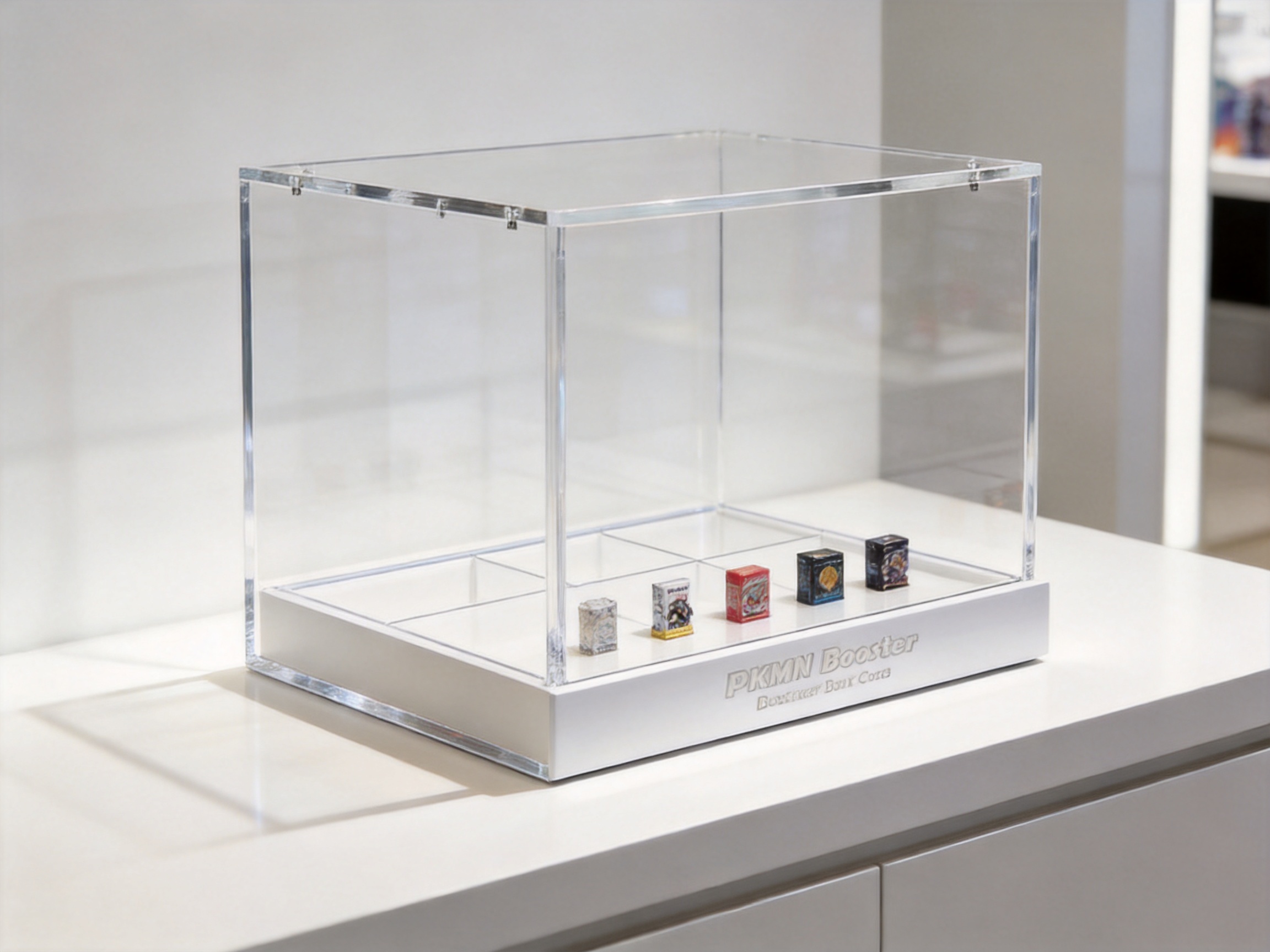
The internal layout is not limited to an empty cavity. Customized bases, dividers, partitions, risers, and support elements can be developed according to the products placed inside. Spacing options from approximately 20 millimeters to 100 millimeters allow the interior to be adapted to different item sizes and display arrangements.
A partitioned interior can prevent products from shifting during transport or routine handling. It can also separate different product variants, colors, sizes, or promotional messages within the same case. A custom base can elevate an item, create a stronger focal point, or provide a stable support surface for irregularly shaped objects.
For sample management, internal organization can help employees locate components quickly. For retail presentation, it can create a deliberate visual hierarchy. For exhibitions, it can ensure that each item maintains a defined position throughout the event.
Flexible Branding Options
Branding is an important part of modern display design. The acrylic case can support logo engraving, UV printing, and other personalized surface treatments. A logo may be placed on a front panel, side panel, base, header, or internal support depending on the visual objective.
UV printing can be used for full-color graphics, product names, campaign messages, patterns, and promotional artwork. Engraving can provide a more subtle or permanent appearance, particularly for logos, serial information, decorative lines, or premium branding concepts.
Customized colors, printed backgrounds, frosted effects, transparent tints, and other surface finishes may also be considered for suitable projects. These options help buyers coordinate the case with a corporate identity, retail environment, seasonal campaign, or exhibition theme.
Suitable for Multiple Applications
The case is not limited to one industry. It can be used for retail product display, sample organization, collection presentation, promotional projects, home decoration, exhibition installations, and branded merchandising programs.
In retail stores, it can display small products, packaged goods, accessories, character items, models, or limited-edition merchandise. In offices and studios, it can organize prototypes, packaging samples, material swatches, and design references. In homes, it can present collectibles, ornaments, miniatures, and decorative objects while helping reduce dust exposure.
This broad application range gives buyers greater flexibility when standardizing display equipment across different departments, sales channels, or product categories.
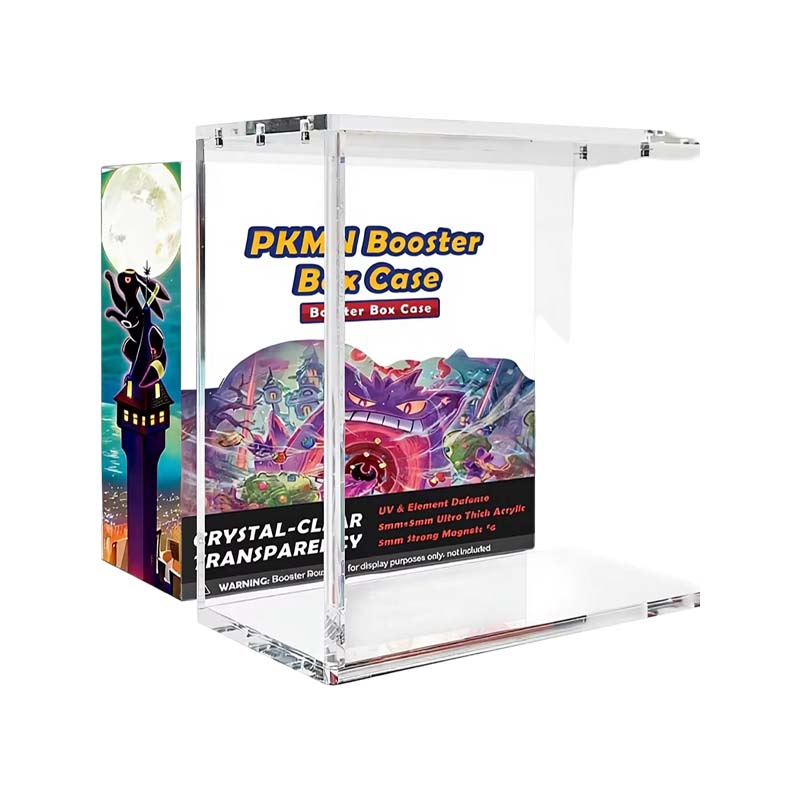
Cube Storage Acrylic Display Case
Material and Structural Design
Acrylic Panel Construction
The core material is acrylic selected for clarity, processability, and compatibility with customized fabrication. Acrylic panels can be cut into precise shapes and prepared for printing, engraving, bending, polishing, and assembly. This makes the material suitable for projects that require more than a basic transparent enclosure.
The recommended thickness depends on the case dimensions, the weight of the contents, the required rigidity, the construction method, and the expected handling conditions. Available thickness options range from approximately 3 millimeters to 8 millimeters. Thinner panels may be appropriate for compact lightweight cases, while thicker panels can be selected for larger structures or projects requiring a more substantial appearance.
Material selection should be considered together with panel size and internal load. A professional manufacturer can review the dimensions and intended use before confirming the most suitable specification. This helps avoid unnecessary material cost while maintaining a stable and attractive structure.
Geometric Cube Structure
The cube format provides a symmetrical and modern visual language. Straight edges and flat surfaces make the case compatible with contemporary retail furniture, minimalist interiors, and organized collection displays. The geometric form also simplifies the planning of multi-unit arrangements.
Although the basic concept is cube-shaped, the product can be adapted to rectangular proportions or other customized dimensions. The external appearance may be changed to fit a specific item, shelf, cabinet, wall system, or promotional installation. This prevents wasted space and allows the case to become part of a larger display plan.
Interior Bases and Partitions
Interior components can be produced from acrylic or other suitable materials according to the application. A base may be plain, printed, colored, mirrored, frosted, or designed with a raised platform. Partitions may be fixed or arranged according to the desired product spacing.
For small merchandise, partitions can create individual compartments that prevent contact between items. For collectibles, a raised base can direct attention toward a central object. For product samples, a modular interior can help separate different materials or versions.
The internal spacing range of approximately 20 millimeters to 100 millimeters provides a useful starting point for layout planning. The final arrangement can be adjusted according to product dimensions, packaging, viewing angle, and the number of items to be displayed.
Advantages Compared with Common Display Alternatives
Compared with Glass Display Boxes
Glass is known for its clarity and hard surface, but it can be heavy and more difficult to process into highly customized shapes. Glass display products may require specialized cutting, edge treatment, and assembly methods, particularly when dimensions or interior structures change frequently.
Acrylic provides a lighter alternative that is generally easier to cut, print, engrave, and customize. This can be valuable for wholesale projects involving several sizes, branded graphics, or repeated design revisions. Reduced weight may also simplify handling, shelf installation, and transportation planning.
The choice between acrylic and glass should still be based on the project’s specific requirements. Where high heat resistance, exceptional scratch resistance, or specialized optical performance is necessary, another material may be considered. For general product presentation, organization, and customized branding, acrylic offers a practical combination of performance and flexibility.
Compared with Ordinary Plastic Containers
Many ordinary plastic containers are designed primarily for storage and may have limited visual appeal. Their surfaces may be less clear, their dimensions may be fixed, and their branding options may be restricted. They often do not provide the polished presentation expected in retail or promotional environments.
The acrylic cube case is designed with presentation as a central function. Its transparent panels, clean geometry, and customization options can create a more premium appearance. Logo engraving, UV printing, internal partitions, and tailored dimensions allow the case to be aligned with a particular product or brand.
Compared with Open Shelving
Open shelving provides easy access but offers limited separation from dust, accidental contact, and visual clutter. Products may also shift position or become disorganized when frequently handled.
A transparent acrylic case creates a defined display zone. The contents remain visible, but the enclosure adds an additional layer of organization and protection. This is particularly helpful for small objects, delicate samples, limited-edition goods, and displays that need to remain neat throughout a retail or exhibition period.
Compared with Fixed-Size Display Cases
Fixed-size display cases can create problems when the product changes or when the buyer needs to use the same display concept for items with different dimensions. Excess empty space may reduce visual impact, while an undersized case may make the item difficult to view or position.
Customized dimensions allow the case to be developed around the product. The buyer can specify the overall size, internal spacing, acrylic thickness, structure, logo placement, and packaging requirements. This results in a more efficient use of materials and space, especially for wholesale programs with defined product specifications.
Manufacturing Process and Production Strengths
Design Consultation and Drawing Development
The manufacturing process begins with understanding the buyer’s product, dimensions, intended use, quantity, branding, and delivery requirements. The design team can review sketches, reference images, product samples, or written specifications and convert them into a practical display concept.
Experienced graphic and product design personnel can prepare design drafts quickly, with draft support available within approximately two hours for suitable projects. This rapid response can help buyers confirm dimensions, logo placement, interior structure, and visual direction before production begins.
Early design review is important because a display case must balance appearance and function. The design must account for panel thickness, assembly method, viewing direction, product weight, internal support, access requirements, and packaging protection. A structured review reduces the risk of avoidable adjustments later in the production process.
Material Inspection
Before cutting, acrylic material is checked for clarity, thickness, color consistency, surface condition, and suitability for the order. Material inspection helps ensure that the finished cases meet the expected visual standard across a batch.
For transparent products, surface quality is especially important. Marks, haze, inconsistent coloring, or visible defects may affect the overall presentation. A controlled inspection process helps identify unsuitable sheets before they enter cutting and assembly.
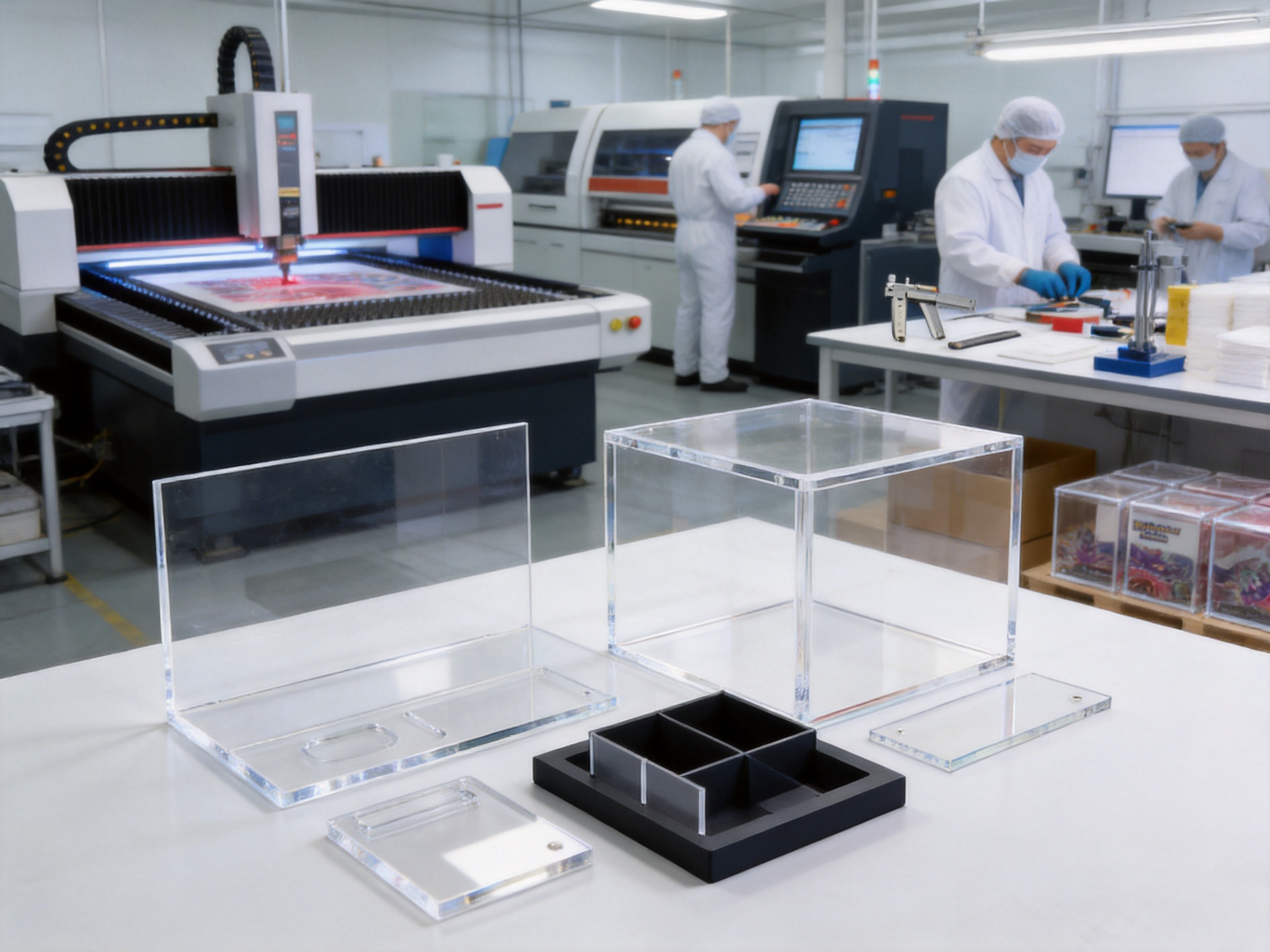
Laser Cutting and Precision Processing
Laser cutting equipment is used to create acrylic components according to approved dimensions and artwork. Computer-controlled processing supports repeatability and helps maintain consistent shapes across wholesale quantities.
Accurate cutting is important for panel alignment, corner appearance, internal partitions, and final assembly. Clean edges also contribute to the professional appearance of the case. The production objective is to achieve smooth, burr-free cutting that reduces the need for excessive secondary correction.
Laser processing can support both standard geometric panels and more customized components. Openings, logo elements, mounting points, decorative details, and internal supports can be integrated into the design when required.
UV Printing and Graphic Application
For projects requiring full-color branding or decorative graphics, UV printing equipment can apply artwork directly to suitable acrylic surfaces. UV printing supports detailed patterns, text, logos, product information, and promotional graphics.
High pattern fidelity is valuable when the artwork includes fine lines, character illustrations, brand colors, or complex visual elements. The design team can review the artwork before printing to confirm scale, color arrangement, transparency, and placement.
Printing may be applied to a front panel, rear panel, base, divider, or other component. The selected position influences the viewing effect. For example, a rear-panel print may create a clean background behind a product, while a front-panel print may function as a direct branding element.
Engraving and Surface Treatment
Engraving machines can add logos, text, patterns, or decorative details to the acrylic surface. Engraving creates a tactile and permanent visual effect that can suit premium, minimalist, or technical design concepts.
Other surface treatments may include polishing, frosting, color effects, and customized finishing methods. The exact treatment depends on the requested appearance and the compatibility of the material with the process. Combining clear and frosted areas, for example, can create visual contrast while retaining the clean character of acrylic.
Shaping and Forming
Some display cases require more than flat panels. Acrylic shaping can be used to produce bent components, formed supports, or customized structural elements. The shaping stage must be controlled carefully to preserve dimensional accuracy and surface quality.
For projects with special geometry, the manufacturer can evaluate the bend radius, panel thickness, visual direction, and assembly requirements before production. This allows the design to remain attractive while maintaining adequate structural stability.
Polishing and Edge Finishing
After cutting and shaping, edges can be polished or otherwise finished to improve smoothness and appearance. Edge finishing is particularly important for transparent cases because the edges are often visible from several viewing angles.
A clean edge can make the case appear more refined and can improve handling comfort. It also supports a consistent appearance across multiple units. The finishing method is selected according to the material thickness, product structure, and required visual effect.
Assembly and Verification
During assembly, the panels, bases, partitions, and supporting components are combined according to the approved design. Workers verify alignment, connection quality, fit, stability, and overall appearance.
Assembly verification helps identify issues such as uneven joints, incorrect orientation, loose components, dimensional mismatch, or improper logo positioning. For wholesale buyers, consistent assembly across the batch is essential because display units are often installed together in the same retail or exhibition environment.
Packaging Preparation
Acrylic products should be packaged carefully to reduce the risk of scratches, impact, dust, or movement during transportation. Packaging design can be customized according to the product structure, order quantity, shipping method, and buyer’s branding requirements.
Protective materials, separators, cartons, and internal supports may be selected to help preserve the finished surface. For larger wholesale orders, packaging organization can also support easier receiving, counting, storage, and distribution at the destination.
Quality Management for Wholesale Procurement
Wholesale buyers need more than an attractive sample. They require repeatable quality, predictable production, clear specifications, and reliable communication. The production system for the Cube Storage Acrylic Display Case follows ISO 9001 quality management standards and includes multiple inspection stages.
Material Quality Checks
Material checks focus on acrylic clarity, thickness, color, surface condition, and suitability for the approved design. These checks are intended to reduce variation between units and maintain the visual quality expected by the buyer.
Dimensional Accuracy
Dimensions are checked against the approved specifications. This may include external length, width, and height; panel thickness; partition spacing; base size; opening dimensions; and logo position.
Dimensional accuracy is especially important when cases are designed for a particular shelf, product package, cabinet, or exhibition structure. Even small inconsistencies may affect alignment when many units are arranged together.
Assembly Inspection
Assembly verification examines whether panels and interior elements fit correctly and whether the structure is stable. The inspection may also confirm that doors, covers, bases, partitions, or other customized components function as intended.
Appearance Inspection
Appearance inspection reviews clarity, edge quality, printing, engraving, surface treatment, visible marks, alignment, and overall finish. The objective is to ensure that the display case meets the expected professional standard before packaging.
Batch Consistency
For a wholesale order, consistency is as important as the quality of an individual unit. Matching dimensions, colors, printing positions, surface effects, and assembly details help create a coordinated display. A controlled production and inspection process supports this consistency across the order.
OEM and ODM Customization Capabilities
OEM and ODM services allow buyers to develop an acrylic display product that reflects their own product strategy or brand identity. The buyer may provide an existing design for production, or the manufacturer may help develop a new concept based on the intended use.
Custom Sizes
External dimensions can be developed around the size of the displayed item, available shelf space, shipping requirements, or a wider retail fixture. The available cube-style size range of approximately 50 millimeters to 300 millimeters provides a practical foundation for many small and medium display projects.
Custom Thickness
Acrylic thickness from approximately 3 millimeters to 8 millimeters can be considered according to the structure and protection requirements. Thickness selection affects weight, rigidity, visual presence, material usage, and transportation cost.
Custom Internal Layouts
Buyers can request bases, dividers, compartments, risers, supports, and spacing arrangements. Internal spacing from approximately 20 millimeters to 100 millimeters can be adapted according to the products placed inside.
Custom Logos and Artwork
Logo engraving, UV printing, and personalized surface treatments can transform a basic clear case into a branded display tool. Artwork may include a corporate logo, campaign message, product name, character illustration, pattern, or instructional information.
Custom Colors and Finishes
Although transparent acrylic is the primary visual concept, customized colors and special effects can be considered. Tinted panels, frosted surfaces, colored bases, printed backgrounds, and mixed clear-and-opaque structures may be developed for particular branding or design objectives.
Custom Packaging
Packaging may be designed to match the product’s dimensions, shipping conditions, and distribution requirements. Branded packaging can also support a consistent customer experience when the display case is supplied as part of a promotional or retail program.
Application Scenarios
Retail Product Display
Retailers can use the acrylic cube case to present small merchandise, packaged products, accessories, character products, decorative items, and limited-edition goods. The clear enclosure keeps the product visible while creating a defined space that can be integrated into a counter, shelf, cabinet, or wall display.
A customized base can help highlight the main product, while a printed background can communicate a campaign theme or product benefit. Multiple cases can be arranged as a coordinated product series.
Sample Organization
Manufacturers, packaging companies, design studios, and sourcing offices often need to organize product samples. A clear case makes contents easy to identify and can reduce the need to open numerous containers while searching for a particular sample.
Partitioned interiors are useful when the case stores several samples or variants. Labels, printed identifiers, and color-coded bases can further support internal organization.
Collection Presentation
Collectors can use the case for figures, miniatures, ornaments, models, memorabilia, and other small objects. The transparent construction allows the object to remain visible while creating a more orderly arrangement.
Customized dimensions are useful because collections often include items with different proportions. A case can be designed for one central item or for a group of objects that share a theme.
Exhibitions and Promotional Events
Exhibition contractors and promotional agencies can use branded cases to present products, prototypes, campaign materials, or special editions. The light appearance of clear acrylic can help maintain an open booth design while still providing a dedicated product zone.
Because the case supports logos, UV printing, and customized layouts, it can become part of the overall event identity. Repeated units can be designed to fit an exhibition wall, counter system, or themed display arrangement.
Home Decoration
In residential settings, the case can be used to display collectibles, decorative objects, small artworks, souvenirs, or hobby products. Its modern rectangular shape can suit contemporary interiors, shelves, desks, cabinets, and display furniture.
The enclosure helps create a cleaner presentation than an open shelf while preserving direct visual access to the contents.
Corporate and Promotional Gifts
Brands may incorporate the case into promotional gift programs, product launches, commemorative sets, or partner presentations. A customized logo, printed insert, or branded base can make the display case part of a complete gift presentation.
For these projects, packaging design and surface treatment can be coordinated with the campaign identity. The result is a practical display item that may continue to be used after the promotional event.
How the Product Supports Brand Presentation
A display case influences how a product is perceived. Clean edges, controlled spacing, and transparent surfaces can make the displayed item appear more intentional and valuable. When the case includes a carefully positioned logo or printed message, it also reinforces brand recognition without completely covering the product.
The cube structure provides a strong visual frame. It separates the product from surrounding objects and helps direct attention toward the intended item. This is useful when the display includes a new launch, premium sample, award, limited edition, or key promotional message.
Brand presentation can be adjusted from subtle to highly visible. A small engraved logo may suit a minimalist design, while a full-color printed panel may be more appropriate for a campaign or retail promotion. The manufacturer can help evaluate the relationship between artwork, product visibility, panel position, and viewing distance.
Benefits for Importers and Wholesale Buyers
One-Stop Customization
The manufacturer supports design, material cutting, printing, shaping, polishing, assembly, and packaging within one coordinated production process. This reduces the need for buyers to manage separate suppliers for different stages of the project.
A unified process can also simplify communication. Changes to dimensions, artwork, finishes, or packaging can be reviewed within the same production system, helping reduce delays caused by fragmented sourcing.
Flexible Trial Orders and Mass Production
The company supports both small trial orders and mass production. The stated minimum order quantity is 100 pieces, which provides a practical entry point for buyers who need to evaluate the market before committing to larger volumes.
Trial production can help confirm the physical dimensions, material thickness, artwork, interior layout, and packaging before a broader rollout. Once the design is approved, the same specifications can be used for larger wholesale production.
Fast Sample Development
For urgent projects, samples may be completed within approximately 24 hours depending on design complexity, material availability, printing requirements, and approval speed. Rapid sample development can be valuable for event deadlines, seasonal launches, promotional campaigns, or product testing.
International Trade Experience
The company has experience serving international customers in South Korea, Japan, the United States, and other global markets. This background supports communication regarding product specifications, artwork, packaging, shipping coordination, and order documentation.
Reliable Production Scheduling
The standard delivery time is approximately 30 days, subject to order complexity, quantity, customization, material availability, and approval timing. A structured production schedule helps buyers plan inventory, retail launches, exhibition participation, and promotional distribution.
Sea Freight Support
For wholesale orders, shipping by sea can provide a practical solution for larger quantities. The packaging method and carton organization can be considered together with the shipping plan to help control transportation risk and improve receiving efficiency.
Recommended Specification Planning
Before requesting a quotation, buyers should prepare the basic information needed for accurate evaluation. This includes the product or object to be displayed, external dimensions, approximate weight, preferred acrylic thickness, number of internal compartments, artwork files, logo requirements, desired surface effects, quantity, destination, and expected delivery date.
Product samples or detailed drawings are useful when the displayed item has an unusual shape. Photographs can help, but precise measurements are preferred for the final design. Buyers should also clarify whether the case needs a removable cover, fixed assembly, open access, stacked placement, wall mounting, or special packaging.
If the case will be placed in a retail environment, the buyer should consider viewing distance, lighting, shelf depth, customer access, cleaning requirements, and the number of units to be installed together. If it will be used for transportation or repeated relocation, the structure and packaging should be evaluated for handling conditions.
| Specification Area | Available or Customizable Option | Planning Consideration |
|---|---|---|
| Case Size | Approximately 50mm to 300mm or customized dimensions | Match the product, shelf, cabinet, or exhibition space |
| Acrylic Thickness | Approximately 3mm to 8mm | Select according to size, rigidity, weight, and protection needs |
| Interior Layout | Bases, dividers, partitions, risers, and supports | Define the number and position of displayed items |
| Internal Spacing | Approximately 20mm to 100mm or customized | Allow sufficient clearance for products and packaging |
| Branding | Logo engraving, UV printing, and surface treatments | Confirm artwork, placement, color, and viewing direction |
| Color | Clear, customized colors, printed, or treated surfaces | Coordinate with brand identity and display environment |
| MOQ | 100 pieces | Suitable for trial production and wholesale procurement |
| Delivery Time | Approximately 30 days | Confirm timing after design and specifications are approved |
| Shipping | By sea | Plan cartons, delivery destination, and receiving arrangements |
Care, Cleaning, and Long-Term Presentation
Acrylic display cases should be cleaned with a soft, non-abrasive cloth to help preserve surface clarity. Dust can usually be removed with a clean microfiber cloth or a suitable acrylic-safe cleaning product. Harsh solvents, rough sponges, and abrasive materials should be avoided because they may affect the surface finish.
When moving the case, it is advisable to support the structure from the base rather than lifting it by a removable panel or interior component. Heavy objects should not be placed inside unless the structure has been designed for their weight.
Display cases should be kept away from excessive heat, open flames, and unsuitable chemical exposure. Although acrylic is practical for many indoor applications, the final placement should be considered during design, especially if the case will be exposed to intense sunlight, outdoor conditions, or high temperatures.
Regular cleaning and careful handling can help preserve the clarity and professional appearance of the case. For retail and exhibition use, a simple maintenance routine can ensure that fingerprints, dust, and small marks do not reduce the visual effect of the display.
Why Choose a Specialized Acrylic Manufacturer?
Working with a specialized acrylic manufacturer offers advantages beyond material supply. The manufacturer understands how design, cutting, printing, shaping, polishing, assembly, and packaging affect the final product. This integrated knowledge is important when the display case includes multiple customized features.
A specialized production team can identify potential problems before manufacturing begins. For example, a logo may be too close to an edge, a partition may interfere with product access, a panel may require additional support, or the chosen thickness may not suit the case dimensions. Early technical review can improve the final result and help control unnecessary production changes.
The company’s equipment includes UV printers, engraving machines, laser cutting machines, and other specialized tools. Together with an experienced graphic design team and established quality procedures, these resources support the production of detailed, accurate, and visually consistent acrylic products.
The one-stop service model also supports broader acrylic merchandise programs. Buyers who need display cases together with acrylic standees, keychains, clips, fridge magnets, wall hooks, badges, or other gifts can coordinate multiple product categories through the same source. This can help maintain consistent artwork, branding, packaging, and communication across a promotional collection.
Frequently Asked Questions
Q1: Can the cube size be customized for different products?
Yes. The case supports customized dimensions and structures according to product size, display requirements, shelf space, and intended use. Cube-style sizes can range from approximately 50 millimeters to 300 millimeters, while other dimensions can be reviewed for specific projects.
Q2: What acrylic thickness options are available?
Acrylic thickness options range from approximately 3 millimeters to 8 millimeters. The final selection depends on the case dimensions, product weight, structural design, desired appearance, and protection requirements.
Q3: Can customers add logos or brand designs?
Yes. Customers can request logo engraving, UV printing, and personalized surface treatments. Artwork can be placed on suitable panels, bases, dividers, or other components according to the design.
Q4: Can the interior include partitions or a custom base?
Yes. The interior can include customized bases, dividers, partitions, risers, and support structures. Internal spacing can be planned from approximately 20 millimeters to 100 millimeters or adjusted according to the product layout.
Q5: Is the display case suitable for retail stores?
Yes. Its transparent construction and compact geometric format are suitable for retail counters, shelves, cabinets, and promotional displays. Branding and printed backgrounds can be added for campaign-specific presentation.
Q6: Can the case be used for product samples?
Yes. The case is suitable for organizing packaging samples, material samples, small product samples, prototypes, and other objects that need to remain visible and orderly. Partitions and labels can improve identification.
Q7: Is the product suitable for home decoration?
Yes. It can be used to display collectibles, ornaments, miniatures, figures, souvenirs, and decorative objects. The modern rectangular structure can fit shelves, desks, cabinets, and other indoor areas.
Q8: What is the minimum order quantity?
The stated minimum order quantity is 100 pieces. The actual quotation may depend on the design, size, printing, packaging, and other customization requirements.
Q9: What is the typical delivery time?
The stated delivery time is approximately 30 days. The final schedule depends on design approval, order quantity, material availability, production complexity, packaging, and shipping arrangements.
Q10: Can samples be produced before a bulk order?
Yes. Sample development is available for design confirmation and quality evaluation. For urgent projects, samples may be completed within approximately 24 hours depending on the design and production requirements.
Q11: What quality checks are performed?
Quality control includes acrylic material inspection, dimensional accuracy checks, assembly verification, and appearance inspection. Production follows ISO 9001 quality management standards.
Q12: Can the manufacturer support packaging design?
Yes. Packaging design can be customized according to product dimensions, shipping requirements, order quantity, and branding objectives. Protective packaging is important for reducing movement and surface damage during transportation.
Q13: Is acrylic better than glass for every application?
Not necessarily. The best material depends on the intended use. Acrylic is advantageous when buyers need lower weight, flexible customization, printing, engraving, and efficient processing. Specialized applications involving high heat, exceptional scratch resistance, or particular optical requirements may require alternative materials.
Q14: Can several cases be arranged as a larger display system?
Yes. Matching cases can be arranged in rows, columns, grids, cabinets, counters, or exhibition structures. Consistent dimensions and finishes help create a coordinated presentation.
Conclusion
The Cube Storage Acrylic Display Case combines organized storage with professional product presentation. Its transparent acrylic panels preserve visibility, while the cube structure creates a clean and efficient display format. Customized dimensions, acrylic thickness, bases, partitions, logos, printing, colors, surface treatments, and packaging allow the product to serve a wide variety of commercial and personal applications.
Compared with ordinary containers, the case provides stronger presentation value and broader customization. Compared with fixed-size display products, it offers greater flexibility for different products, shelves, collections, and promotional concepts. Compared with heavier glass alternatives, acrylic can provide a practical balance of clarity, weight, processability, and branding potential.
The manufacturing process is supported by laser cutting, UV printing, engraving, shaping, polishing, assembly, and controlled inspection. The company’s design support, international trade experience, flexible trial-order capability, and one-stop customization service help buyers move from concept to finished display product with greater efficiency.
For retailers, importers, collectors, exhibition organizers, packaging companies, and brands seeking a reliable presentation solution, this acrylic cube case offers a combination of visibility, organization, customization, and production consistency. With accurate specifications and clear communication at the design stage, it can become a practical long-term component of a retail, promotional, collection, or sample-management program.
References
1. International Organization for Standardization. ISO 9001 Quality Management Systems: Requirements.
2. Acrylic Sheeting Manufacturers Association. General Information on Acrylic Sheet Properties and Fabrication.
3. Society of Plastics Engineers. Principles of Thermoplastic Processing and Surface Finishing.
4. Retail Design Institute. Principles of Product Presentation, Display Planning, and Visual Merchandising.
5. Packaging Institute. Guidelines for Protective Packaging of Customized Display Products.
6. Manufacturer-provided product specifications for the Cube Storage Acrylic Display Case.
7. Manufacturer-provided information regarding acrylic cutting, printing, engraving, polishing, assembly, quality inspection, and packaging processes.
Product: Cube Storage Acrylic Display Case


Ready to Begin?
Product Categories
Contact Information
 Email:
kaelissia.shop@gmail.com
 Phone:
+86-18968933800
 Address:
No.515, Lingxi Strait Avenue, Cangnan, Wenzhou, Zhejiang, China
QR Code
Copyright © Wenzhou Chuangheng Packaging Co., Ltd. All rights reserved.
